

Infinite Jest
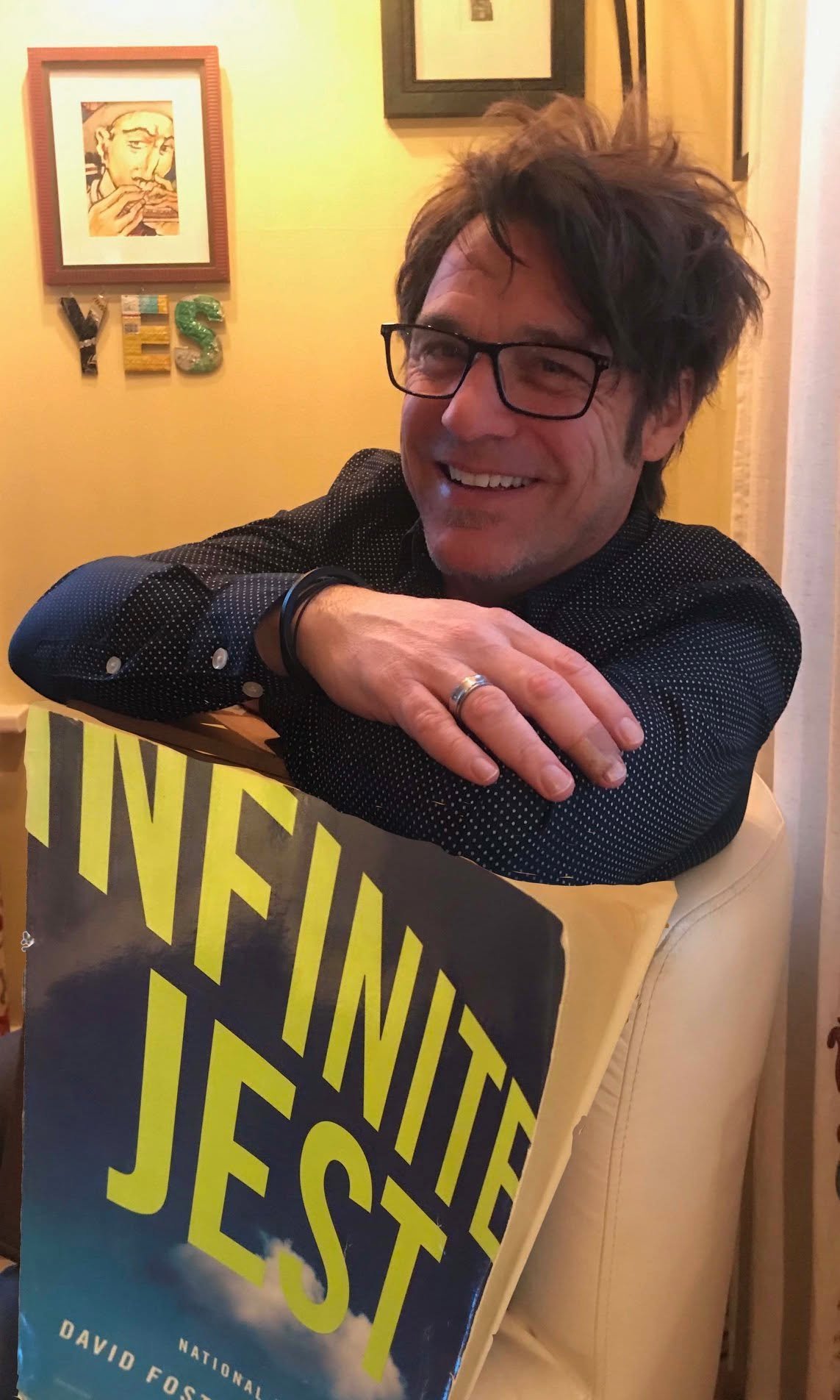
We interrupt your regularly-scheduled coverage of the collapse of civilization to bring you this unsolicited book report.
INFINITE JEST, DAVID FOSTER WALLACE-- 1996. BACK BAY BOOKS 1079 PAGES
*************************************************************
It’s not like I just go rushing to the dentist with every new tooth decay. But 29 had pretty much been reduced to rubble, so I scheduled the crown in an attempt to avoid a canal. I knew it would be a long appointment with built-in breaks, so I brought noise-cancelling headphones and a book the size and approximate density of a cinderblock. It doesn’t as much sit in your lap as on it…
“I see you’re reading Infinite Jest,” remarked my DDS, a skilled craftsman but not someone I consider a particularly agile small-talker. “Are you enjoying it?”
I said I didn’t think enjoying was the right word-- but that like it was powerful literature, sure.
“I haven’t read it,” he admitted, sitting to my right, already holding the syringe. “It’s kind of about dysfunction, isn’t it?”
The novocain shot is always the worst part. I looked from him to the needle, then back at him. The dental assistant was behind me, to my left. No one spoke or moved for what seemed like a very long moment, even considering how compressed time can feel in the dentist office. Eventually I rested my head back in the cradle of the chair and said ‘yes.’
“Alright Jeff,” he chirped buoyantly, the same as if I’d responded to a comment on the weather. “I’m gonna ask you to open up real wide for me...”
*************************************************************
The Boston Globe called Infinite Jest rabidly intelligent. The Atlantic Monthly proclaimed it a work of genius. Harper’s Bazaar said it was a sprawling piece of intellectual wizardry & social satire-- that it was at once serious, diagnostic, frightening, and lyrical and describing author David Foster Wallace’s imagination as limitless.
But those are dustcover reviews, probably commissioned. I’m writing a book report for free, because I’m out of episodes of Netflix or something. And book reports are supposed to like say what a book’s about.
I wish I knew...
My dentist hasn’t read it but even he knows it stars D. Function. And while there’s a lot more to it than that, he’s not incorrect-- neither is he the only one who hasn’t read it. Infinite Jest is among the most widely unfinished books of the last century. How many copies slouch on low shelves, sneering at lesser works-- a forgotten bookmark sticking out a third of the way through?
Most of my favorite books are short: Breakfast of Champions, Fear and Loathing in Las Vegas, The Crying of Lot 49. You can read them in a weekend or in three baths if you really want. I liked Jonathon Livingston Seagull. Infinite Jest is a thousand rigid pages, the last hundred of which is an appendix of 388 errata drawn from the body of the novel. Some are as brief as #349 which simply reads [sic]. Others are lengthy (#110 is 19 pages) often with multiple footnotes of their own, meaning you need two bookmarks and a string tied to your ankle to find your way out of the somehow even more densely-leaded forest of errata (9pt!). Many of these asides feature complex underplots and formulas, graphs, unredacted field interviews and supertechnical social schematic equations related to concepts that increasingly diverge from the original footnoted idea 748 pages prior that you forgot about altogether and are subsequently surprised to be reminded of once you do finally return to the original like jumping off place.
I’m a slow and very linear reader. I read every word without skipping discriminately ahead UNLIKE SOME PEOPLE I KNOW and I don’t employ ghostreaders. I did read every page of Infinite Jest, many of them more than once. My pace-- call it steady-- is not complicated by the squinting associated with decoding metaphor and symbolism. When a white horse vaults a split-rail fence at the climax of a passionate love scene, I just go ‘huh.’
All good and well-- but what is it about?
Even DF Wallace didn’t always appear to understand exactly what Infinite Jest was about. While he did say in 2003 that it’s fairly clear ‘what happens’, he also conceded a certain lack of resolve, (dis)claiming “the answers all exist… (but) out of the right frame of the picture.”
“The story can’t fully be made sense of,” he admitted. Then he committed suicide in 2008.
So I think in terms of conventional like book report gradings, this one should be a sliding scale even though I don’t expect full credit since I’m turning it in 20+ years late…
*************************************************************
Insomnia is not without its benefits. I’m not usually relaxed enough to enjoy fiction when anyone else in my household is awake-- so most of my reading is done in the very dark of night or the gathering dawn. Merely sayin’-- and also copping that I would never have read this fucking book without this past six months’ reliable sleeplessness. Still: even during the day I could feel it staring at me, and more than once had to get up and put it in another room or otherwise out of my sightline. It’s no pamphlet; if it’s in the room, you can see it.
Infinite Jest starts in the future and ends in the past. At times hyper-precise as if written with a slide rule and ton of cocaine, while other times rambling and tangential as if transcribed from a voicemail left from a moving vehicle, it often feels like the Sympathy for the Devil movie-- a ponderous panning of seemingly unrelated vignettes depicting abstract violence and torture, a macabre theater of uncooked spaghetti right up the ol’ urethra.
The characters are almost universally unlikable. I guess I kind of rooted for Gately, and Mario is at least happy even if it’s only because he doesn’t know any better. Pretty much everyone else is deeply flawed and/or irreparably damaged: criminally insane, grotesquely disfigured, racist, narcissistic and addicted. The antagonist and title entity is a movie made by one of the co-protagonists’ late father which is so mesmerizing that anyone who views is dies within days because of their immediate loss of interest in anything else other than watching the movie-- including food or water. Infinite Jest quite literally entertains people to death.
The governments of what was formerly known as the United States, Canada and Mexico are spying off on each other, trying to locate the master copy of the film in order to eliminate the maps of the other countries’ populations. No one really succeeds (at least within the boundaries of the rightmost frame).
Generations of adolescences are spoiled by performance anxiety at a prestigious tennis prep school in New England. The Enfield Tennis Academy is covered in snow in its last appearance in the book.
Chemical dependence is a leading character and often manifests itself as the ghost of Recovery, specifically Boston AA. But despite the longterm sobriety of many of the ‘crocodiles,’ there are no blue skies or renewed leases or any actual redemptions seemingly for anyone. Rather, it is the ragged-right, secondhand smoke LABOR of Recovery—the plodding, rote obedience to a dogma that no one seems to truly understand or really even Trust, entirely. It’s a cruel swirly, but the best chance any of them have to stay alive-- so they keep coming back…
All that stuff happens, but I don’t think it’s really what the book is about.
***************************************************************
I don’t know if Infinite Jest is as hard a read as Gravity’s Rainbow or the Holy Bible—I’ve never read either. But after 800 pages of menacing concave ceilings, obsessive turd-tallying and repeated uses of words that not only do we no longer use in literature today but in truth were already not using in 1996—a reader kind of feels invested and that he might as well like finish. This is a great time for main characters to abruptly and without explanation begin speaking in first person after being portrayed till now in the third. This is the perfect time to provide detailed physical characteristics of main characters who to this point have not been described and to whom-- naturally and by necessity-- a reader has already assigned their own physical images. This is the ONLY sensible time to descend into a 36-page fever dream, fully eight of which are one single uninterrupted paragraph. Multiple colons in many sentences, levitating above the paper towel dispenser-- top hats for all my friends!
Because it does take six months to read. At least it did for me. To be fair, I did put it down between Thanksgiving and New Year’s as a Christmas present to myself. But it’s not like I felt any more or less hip after my winter break. It was still just as greasy a fistful of stories of Disease, abuse, disconnection, generational abandonment and unhealthy relationships between adults and minors—all running more-or-less parallel, sharing the same unfiltered tank asking what’s water. The apple (or pear, plum or peach) does not rot far from the tree...
Oh, it’s SUPER funny—don’t misunderstand me on that. DFW is a master of catch-and-release humor that elicits lolling about even the least-conventionally hilarious topics. As flung as this book seems at times, one does get the feeling eventually that there is not a single word out of place. What might be casually read or excerpted from the greater work could come off as random, but I don’t think there are any accidents in Infinite Jest. It is much more than the sum of its riddles, but I for one am going to have to read it again to understand exactly how much more.
Just probably not right now. Maybe a little Raymond Carver while I rest.