

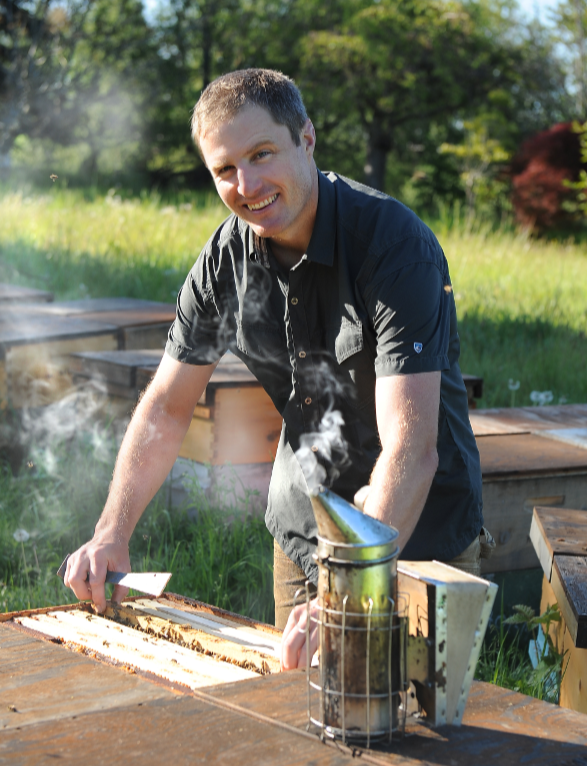
“I bet we don’t even get stung tonight.”
Most jobs have some occupational hazard or another. For beekeeper Rob Rienstra, that hazard is getting stung by bees. Often in the face. Sometimes dozens of times each day.
But not tonight. At least he doesn’t think so.
It’s a crisp late January dusk in Bellingham, and Rienstra is unloading his forklift from the flatbed truck in one of the many Whatcom County ‘yards’ in which he keeps bees. This evening, he’ll load twenty pallets of four colonies each onto the truck and drive them 15 miles to Deming where he’ll unload them all again. We’re talking about between 25-30,000 bees.
And he doesn’t think he’ll get stung in the face, even once?
“When their economy is good, they’re thinkin’ about other stuff,” he shouts over the diesel putter of the forklift. “Just like anyone.” At this time of year, the bees are quite content to stay deep in the hive and binge on Netflix or whatever it is they do in there. The rumble of the forks, the shaking of the truck—none of it is bothersome quite enough to draw many of them out into temperatures in the mid 30s.
At the moment, the rest of the meadow is still. The tracks of Burlington Northern Railway are visible to the west, and the flight path of Bellingham International Airport directly overhead, but there’s no traffic. The pale winter sun is dropping into Bellingham Bay and a Heron drifts lazily along the treeline at the edge of the clearing. Rob Rienstra’s bees seem indifferent.
These bees and their homies will produce as much as 25,000lbs of raw honey for Rienstra’s BeeWorks Farm this summer. It will be jarred by-hand by Rienstra and just a pair of seasonal employees. Eventually, BeeWorks’ six varieties will make their way to the shelves of the two Bellingham Community Food Co-op locations and all twelve PCC stores in the Puget Sound area.
But first, a working vacation to California. Swimmin’ pools. Movie stars…
Rienstra will spend the balance of this week gathering all the rest of his colonies from various yards around Whatcom County and staging them at the Log Show Grounds yard in Deming. Once they’re all in one place, a larger flatbed will arrive to collect all the hives for the 700-mile trip to California’s Central Valley where they will spend six weeks pollinating almonds.
With California almond orchards having nearly doubled in the last decade to more than 1.3 million acres, nearly every commercial colony in the U.S. is needed to pollinate the crop. BeeWorks’ bees are part of that effort.
Rienstra is hoping to take a quick trip to Vietnam while his stock is sunning out-of-town. Because once they’re back, his season will have begun in earnest. And though the busy season for a northwest beekeeper is hard work, Rienstra is grateful he’ll have bees to keep.
It’s no secret that bee numbers globally have been in-decline for decades. But a tenacious and troubling parasite known as the Vorroa Mite has been particularly hard on regional keepers this year with 50% winter ‘deadouts’ widely reported, and some numbers as high as 80%.
Rienstra is relieved to have experienced much lower numbers in his own colonies, and looks forward to their return to Whatcom County by the end of March—bulked up from their work in the almond orchards and ready to go to work on local raspberries and of course turning out plenty of that sweet nectar.
************************************************************************
Rienstra gets stung on the wrist, below the cuff of his honey-colored Northface puffy. It doesn’t even interrupt his sentence, let alone elicit a wince. At this time of year he doesn’t bother with the hood or even gloves beyond what he needs to keep his hands warm. The Carhartts (also coincidentally honey-colored) are worn for their durability—not protection.
Bees are everywhere in Rienstra’s world. In his hair, in the truck, on the laundry room floor when he shakes out his clothes at the end of a day. When driving through his Sunnyland neighborhood two summers ago, I observed what looked like a cloud of smoke hovering around his Dodge Ram 1-ton work truck. As I drew closer, of course, I realized it was a swarm of bees. As I drove through, a dozen were sucked in through my open sunroof. They buzzed blissfully around a few seconds before realizing they’d been separated from the party at which point they floated out the way they’d come and beat it back to the truck. Like a cartoon.
Thinking maybe there’d been a jailbreak, I stopped and knocked on Rienstra’s door.
“Dude, are your bees escaping?”
Rob smiled and stepped out onto the porch.
“Yeah, those aren’t my bees,” he said, gazing in the direction of the truck. “They’re from another colony in the neighborhood, just moving in. Want to go see them? It’s pretty cool…”
We walked nonchalantly into the swarm and up to the truck. The sensation was striking—not just the raw sound of the buzzing, but a particular energy to it also. A true vibration. Rob actually had to raise his voice to explain to me that a scout from an amateur keeper’s neighborhood colony had discovered Rob’s hives on the back of the work truck and had sent for the queen. By this time, her highness is already inside, and layers of perfect honey bees coated the outside of the wooden crates like mold on forgotten cream cheese—waiting their turn to climb inside through the slits in the boxes. The bees could not have been less-concerned with us. Their current economy was good.
I asked Rienstra how many bees were here right now. He counted the hives strapped to the back of the truck, doing some quick bee math in his head. He shrugged.
“Ten thousand maybe,” he said.
***********************************************************************
By April 1st, Rienstra’s bees are back from California and ready to get to work locally. Having faired well in terms of survival, he is optimistic— but still concerned about the year’s early spring.
“Plants respond to weather,” he says, ratcheting taut a strap over another stack of what seems like an endless sea of 16” x 22” wooden hives. “And bees respond to plants. You can’t plan it.”
Having been in the business ten years, Rienstra knows that early springs don’t bode for bumper honey years. A later, more dramatic bloom is a much better for the long game, but he and his bees will make the best of what Ma Nature provides. To a point. There’s definitely some tinkering involved.
When explaining the mystery of bees and how they not only produce honey but also facilitate the pollination of most other plant species, Rienstra’s sentences often begin with the words ‘in nature.’ In nature colonies don’t re-queen themselves at the same rate as kept colonies. In nature, when a colony reaches a certain capacity a mother queen is liable to bolt, taking a percentage of the colony with her. If a keeper doesn’t provide a new hive for the colony to move into, the colony will be lost. In nature, the first hatched new queen systematically destroys the embryos of her yet un-hatched rivals. It’s pretty gnarly—bee eat bee one might say. So a little delicate human intervention goes a long way.
Rienstra will purchase hundreds of queens this season from a source in California that does nothing but raise queens. The work of a modern commercial honey producer like BeeWorks involves a lot of property management—constructing new hives, and moving them around from one location to another in order to provide a steady source of food for a colony whose members still might travel more than two miles in any direction to find their favorite nectar. But magically they’ll return to the brood and their queen at the end of the day.
“I love driving a truckload of bees up the craziest mountain roads late at night in July,” Rienstra says in May. “I think about, read about, weigh every action to its impact on the health of my bees. I relish camping out in the mountains near them after delivering them to a new pasture.”
It hasn’t always been what Rienstra refers to as a cowboy’s life. He studied bio chemistry in college and went to work for Merck after graduation, pedaling vaccines. Beekeeping is related to his formal educational background too, but much more in-line with his true passions. But it took a decade in the race before the universe showed him a path to a more-fulfilling life.
He got a colony of bees for kicks at age 34 and then a second. “I was crazy about it as a hobby,” he said. “Couldn’t get enough of it…” But still the missing piece was how to parlay his maturing skills and resources into a living.
Serendipitously, a mentor eyeing retirement offered to sell the protégé his 150 colonies, and the decision wasn’t a hard one. Rienstra traded in his sample case and box of logo’d ballpoints for Carharts and a bee veil and the rest is history.
Rob Rienstra relishes the rare combination of science, food, nature and community in his work. He reflects back on a term working at a bakery in Switzerland during college as a pivotal point in his recognition of the importance of quality, organic food in society. He considers his contribution to Western Washington’s food economy a gift unlike that of most conventional farmers.
“It’s the grand collision point for my sense of adventure and my love of quality food,” he says, considering his place in the food chain. “I feel a responsibility for this.”