

Rush— Climate Pledge Arena, October 2026
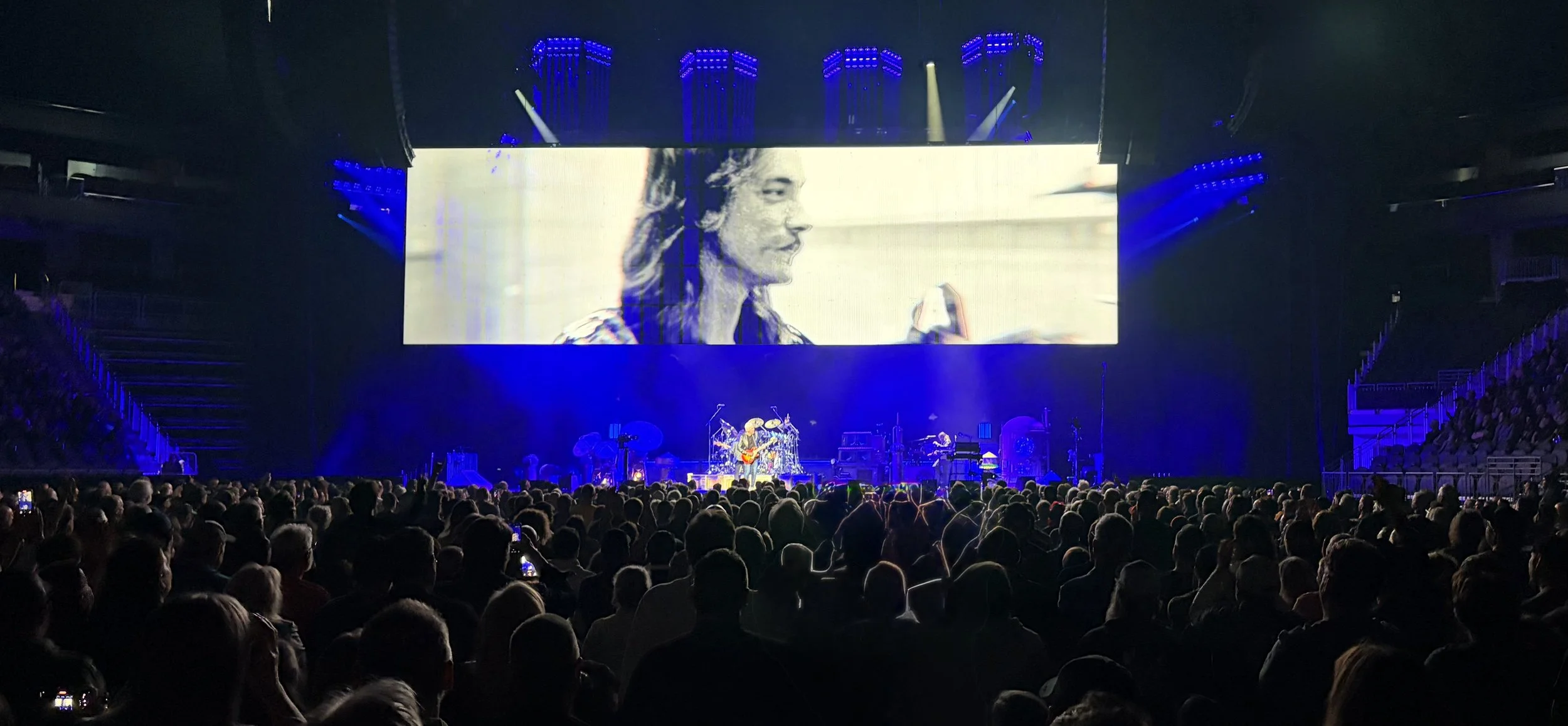
There was a time in my youth when I would attend three arena shows in a month. Music was my life, tickets were $9, and not only did I not mind pressing in tight with strangers in a violent pit of sweat & bile, but I actually kind of lived for it.
These days I can often be heard saying I can’t imagine who it would take to get me into an arena. Any artist with personal allure sufficient to cause me to consider waiting in lines with 12,000 other aged honkies has been dead or otherwise grounded from touring for many years.
Rush was no exception. I thought it was an interesting story that they were going out 5 years after the death of their iconic drummer and lyricist Neil Peart. Rush is a 3-piece band. It’s not like AC/DC or Spinal Tap replacing another drummer. This is like removing one of the legs of an equilateral triangle, upsetting a historic equipoise and risking scorn— or worse, indifference— by duct-taping in a replacement flank. Pinch-hitting for one of the most beloved musicians the genre has ever known.
With a girl. They were replacing Neil Peart with a girl.
Not for one moment did I consider attending. Not out of outrage necessarily, or even because of the economics— but rather out of apathy and dread of the lines and the general inconvenience of the whole self-conscious affair. A hard pass and an easy choice.
The tour started without me in June. Four nights at the Forum in LA before meandering east and north, seemingly in little rush to get to Seattle by mid-October. I wasn’t actively tracking it, but when I did observe a reference on social media, the reports were always glowing. Typical. Anyone going to see 2/3 of Rush in 2026 was there on purpose. Of course they’re going to say it was amazing. Good for them. I’ll just stay home and listen to the first side of 2112.
So when Larry messaged after 10pm the night before the second Seattle show, asking if I wanted my God Son’s ticket for the following night, my immediate reaction was fuck no.
“Of course,” I was surprised to see myself thumb out in reply. “See you tomorrow.”
Dig Larry, though— seriously. I’ve known him since I was 12. He’s the first Canadian person I ever knew, or at least the first person I ever knew was Canadian. He had dual citizenship because his mom was from Nova Scotia and he was proud to say it, at a time when the rest of us were still making jokes about Canada, eh. He was proud of his heritage and he loved hockey and Rush. Still does.
I hadn’t seen Rush since the Moving Pictures tour, in June of 1981. I left that show pissed at them because they didn’t play ‘Working Man’ and because there were too many synthesizers for my burgeoning metal tastes. Rush and I kind of missed each other in that regard. I’d been listening to their earlier stuff for years, but by the time I got a chance to see them live, they had transitioned. And we continued going our separate ways. I didn’t resent them, but I also never owned Grace Under Pressure, if you know what I mean.
Back in 81 there were no bars in the Seattle Coliseum. Not one. Not that I’d have been able to purchase an Orange Crush w/ Southern Comfort, which was what we were drinking in the parking lot before the show. I would not have been able to make that purchase because I was 16 years old. But now Climate Pledge Arena is all bars—there are more than thirty of them. Thirty bars! No one smokes a big fat joint like in 81, but everyone’s got a $22 drink in their hand. I’m not sure if this is progress or not. I found Larry and we hit a tequila kiosk before making our way to the floor and our seats.
When the house lights went down, the 25’ square video screen at center stage lit dramatically up with a corny Ai image of a castle that looked like the cover of a YA novel. An alarm went off somewhere deep inside myself as I thought I’ve made a terrible mistake. Word was that the band would offer a 90-minute set followed by a 25-minute intermission before another 90-minute set. My head floated up into the rafters of the arena, peering down at my seat and picturing myself gasping for breath three hours later as Rush worked methodically through their entire monotonous mathematical completist elitist catalogue, hitting every studio album from the last 40 years— forgotten titles like Test for Echo, Vapor Trails and Presto. Would there even be time for ‘Working Man?’
But I’ll just get this out of the way right fucking now: everything that happened from this point on was absolutely sensational. I had not previously understood it could be like this. Oh my God.
The film intro lasted 7 minutes and included cameos by the Southpark crew and the I Love You Man dudes, before finding Geddy & Alex made up to look even older than they actually are and that’s pretty old. At the end of the reel, the band magically appeared on the stage and burst triumphantly into ‘Xanadu.’ The thing was on.
Geddy Lee and Alex Lifeson are both 73 years old and they’ve known each other since middle school, just like me and Larry. They’ve spent a lot of their lives on the road, shoulder-to-shoulder on stages and in vans, buses and planes. Indeed, this is the band’s 50th anniversary tour. They perform for 3 hours every-other-night. I have no idea how they are able to do this, but it certainly appears as though they are still enjoying the heck out of it.
Playing electric guitar for 3 hours is one thing. They both do that. But Geddy Lee’s famous falsetto singing style is not one conventionally associated with men in their 70s. I’ve seen a lot of aging rock singers in-concert who I later wished I could have un-seen, but we all know it doesn’t work that way. I was apprehensive about how Geddy would (could) perform, but for 3 hours he sang (mostly) like it was 1977. Maybe they avoided a song or two, and he definitely worked around some vocal boobytraps by finding complimentary notes to substitute for riskier ones. But it also wasn’t like he sang everything an octave down or just avoided certain passages altogether. Instead, there had clearly been a careful study of every song, line-by-line. He found an honorable path to the ending of each number, and it was quite breathtaking, honestly. Not only well-executed, but exceedingly well-designed. Geddy Lee of Rush!
The set list itself was entirely respectable. In addition to opening the second set with Moving Pictures in its entirety, the 80s were well-represented in selections from Signals and Power Windows—records I never owned, but songs I knew from the radio. They closed the first set with ‘The Spirit of Radio’ and the second with an abbreviated 2112. I would have traded some of the 90s stuff for ‘Bastille Day’ or ‘The Trees’ but it’s also true that I was spared ‘Fly by Night’ and ‘Kid Gloves.’ And yes: they did play ‘Working Man’ (first encore) and By-Tor (second).
Almost as soon as the show began, this dude to my left started wailing along with every song. Zaaan Aaaah DOOOOOO! Jesus God, this guy was the worst singer I’d ever heard and he seemed to know all the words. He’s got a problem with his POisons! I was about tell the dude that I couldn’t hear Geddy when I realized it was my oldest friend in the world— Larry shrieking gleefully out along with his heroes. His oldest and youngest-born were to my right and they didn’t seem bothered by their fathers’ bellowing in the least. They’d grown up with it. These two siblings were every bit as fanatical about Rush as Larry, each of them with a wishlist of obscure songs they hoped would make the set. They had both seen the show with their father two nights earlier and couldn’t get seated fast enough for another 3 hours of their favorite band. I’ve known both these kids their whole lives and truly enjoyed sharing the experience with them. We all sang along. The River!
I am not a big fan of video screens at concerts. I understand their function, but my favorite historical arena rock experiences have not included giant video screens showing the cheap seats what they’re too cheap to see with their own eyes. But the way Rush used this network of screens and other technological wizardry was quite incredible. And of course the theatrical presentation of the show wasn’t limited to the screens, but also included holograms, pyro, dry ice and freaking lasers, duh. Still, none of it seemed cheap or patronizing. Each song had a completely different combination of moving screens and employment of the 40’ cage that raised and lowered over the stage to house various characters and steampunk accessories—not to mention the 30’ Priests of Syrinx. Bats and crows fluttered, columns of smoke rose and the Red Barchetta sped through the valleys and mountainsides of the virtual moving picture landscape. It was a multi-media masterpiece, brilliantly conceived and conveyed.
And sweet baby Cygnus, the sound was so good! It was warm and organic and sounded merely like an amplified version of what the musicians were actually playing as opposed to an over-processed swimming pool of oatmeal like most modern rock live sound. The vocals were clear and not over-effected. The guitars were clean and not over-driven. The minimal backing keys were discrete. And the drums, well—they were rad.
It’s hard to imagine the burden carried by Anika Nilles. Playing Neil Peart’s drums, can you imagine? I don’t know who she is or how this connection came to be. But she carried herself with supernatural poise and played Neil Peart’s drums like a boss. She did not seem to miss a beat, and the sound itself was clear and distinct, not a plastic surgery tangle of false boom & bottom. A single bass drum she played! Again—can you imagine?
And I had wondered, lying in bed Sunday night after telling Larry I’d go to the show. I’d wondered about the elephant in the arena. I’d wondered how the surviving members of Rush would acknowledge the notion of Neil—a presence that must hover over every note of every song they play. (Except ‘Working Man.’)
And honestly, I thought they played it beautifully. I’m normally against these types of carry-ons (see: Thin Lizzy late 90s, Alice in Chains, Foreigner, the Sex Pistols, etc) but somehow this whole after-Rush spectacle felt fair—super dignified & deferential, of course, but also just kind of natural. The tributes were numerous, but never were they maudlin or mawkish. There was monumental reverence articulated-- but through humor and disciplined editing, the segments were kept brief and a lot of the heaviest emotional lifting was actually done with the screens as the band played a melancholy soundtrack. An edit of interview clips rolled before ‘Bravado’ and especially the riderless motorcycle sequence over ‘Time Stand Still’ was pretty darned moving. A fitting tribute to a musical Saint.
I’m glad I went. Maybe once in a while, just sometimes—you actually can go back…