

Mike Egan
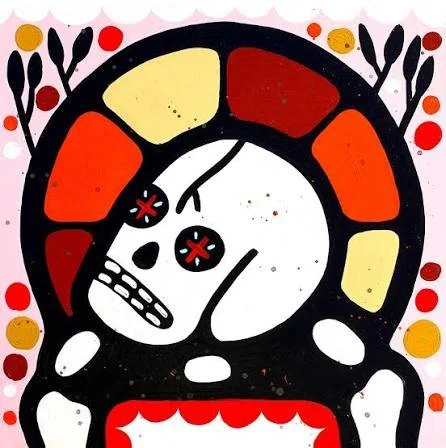
Mike Egan likes skulls. He likes drawing them, painting them and making toys of them. He likes wearing shirts with skulls and having skulls tattooed on his adam’s apple.
Skulls!
And after imaging skulls for decades, he really knows his way around them. It seems safe to assume that Mike Egan never met a skull he didn’t like.
But skulls aren’t all Mike likes. He also likes skeletons. And crosses and coffins. Bats and the great cats. But most of all skulls.
Images of death feature prominently in Egan’s work, but it is supertrue that without life there can be no death. And in the brightly-hued iconographic deathscapes that Egan transfers so eloquently from his imagination to canvas, the melancholy agreement between death and life is on display in a vibrating dimensional contrast.
It borders on punchline that Egan spent five years working intimately with the dead as a funeral director. But it’s true. Truth stranger than fiction; life (and death) imitating art; the barefoot cobbler. All of it.
It almost didn’t happen. Egan was content working at the airport on September 10, 2001 but the next day found himself without no job after the industry was hastily shuttered. In trying to decide what to do next, he saw an ad for a mortuary school and noticed it only took a year to get certified. One year later, he was apprenticing—shuttling cadavers, embalming them, dressing them and making them up for viewings.
And this was the part of the job Mike Egan dug and was good at. The art of it. He had no interest in selling caskets. He wanted to work with the color and costume. He wanted to be part of the presentation. He wanted to work with the skulls.
“There’s restoration that needs to be done sometimes,” Egan told the PMA podcast in S2/E5 during the spring of 2024. “That’s where I really shined because I was good at mixing colors.”
Egan’s empathy for strangers who were navigating the delicate footing on both sides of a new death was on-display, from the gallery of a mortuary prep room.
“If I’m not able to do that,” he said of staging a body for an open casket funeral, “then that person’s family & friends aren’t able to see them one last time to pay their respects.”
“It’s huge,” he added.
But as committed as Egan was to his work in the death business, it was never a career—any more than working at the airport was. Anything Mike Egan has ever done other than art was only a means by which to pay rent and acquire art supplies in order to continue making more art.
He was always that kid. He was always the one who could draw stuff. Even before he was drawing skulls.
“It was like my super power,” he said of finding his skills, growing up in the 80s outside Pittsburgh. “There were kids that could beat up other kids and there were kids who were funny. I was always the kid who could draw really good.”
An adolescence of drawing good led eventually to studying fine arts at Northwest Pennsylvania’s Edinboro University. Egan’s first passions there were printmaking and woodcut— mediums that would inform his future style in the employment of bold line work. But the realization of that style was still a long way from Edinboro. Egan describes the work he was doing there and in the earliest days of his post-grad career simply as ‘bad.’ On his own website, he even capitalizes it—what’s known in the art world as really bad.
It got better. A lot better.
Today, the style in which Mike Egan seems to have been born painting is instantly recognizable from across any gallery. The images are so percipient it often seems as though it’s the work that’s studying the viewer—rather than the other way around. The skulls, sure, but also the ghosts and demons; the vines and tears and juice glasses. The lucent colors vibrating off the ofrendas of the simple polka screens. The symmetry and the rhythm.
Egan’s paintings have definite music to them, less melody than beat. Order without predictability. The trance of the dancing skulls.
But all this death is not without humor! One need only pour through the titles of Egan’s creations to understand there is some tongue-in-cheekbone to be acknowledged. Paintings like What’s Inside a Cat, Delivering Lucky Coffins and of course We Want Skulls have hung at shows called Sorry For The Blood (Albuquerque, 2010) and I Saw You at my Funeral (Chicago, 2016). Steeping in the image of Hide Us on the Inside Where We are Safe, it’s easy to see at least the irony in Egan’s work—if not necessarily the funny ha-ha.
There’s a lot of Mike Egan in each of his paintings. Heavy in relicism from the leftovers of his Catholic upbringing, and his personal numerology is manifest in lots of 7s and of course 13s. The conventionally lucky juxtaposed with the famously less-lucky. White and black. Death and life.
“I love the idea of being able to tell a story about myself through my artwork,” he said in description of his work. “I like the idea that my paintings are more about my life and in a way memorializing myself. I’m physically going to die one day, but through all this artwork that I’m putting in the world I’m never really going to die.”
“So it is a way of painting your own obituary.”