

Stop Draggin’ Me Down
When it was time to re-re-issue the Mono Men’s first record Stop Draggin’ Me Down, Dave Crider asked Callous French to write some liner notes.
Crider said ‘the guitars aren’t loud enough’ and Marx agreed. ‘Needs more guitar.’ This went on until Conrad stood and stepped away from the console.
“Turn em up as loud as you want,” he said. “I’m going upstairs.”
And that’s how it started. Give a horny young band enough string while they’re making their first record and you may just have had a hand in creating a monster. Even if you never see them again, you’re sure as hell going to hear them— because the guitars are so fucking loud. Everyone could hear the Mono Men in 1990. Even some who were actively trying to get away from that sound could hear them—because Conrad told them they could turn the guitars up as loud as they wanted.
“They weren’t loud enough before,” Crider and Marx agreed.
Of course there’s a lot more that went into making Stop Draggin’ Me Down a garage rock waypost—stuff like drums and bass and vocals. But on the debut—and on every subsequent Mono Men recording throughout those buzzy 90s— it all started with the guitars.
There was no automation on the Egg board. Turning the guitars up as loud as those knuckleheads wanted wasn’t done with a mouse. They had to push the faders up manually: all hands on deck! Then the tracks went straight down onto tape—no files or hard drives or digital backups. It was hard work, like licking a thousand stamps. Then once the guitars were loud enough, the masters got delivered to the pressing plant (in a car) and the records shipped back (in a box) and the product sent to the press (in the mail) and radio stations were called (on the phone) and asked nicely to play it.
“College radio promotion turned out to be pretty important on that first album,” said Marx via satellite, reflecting back on an era of doin’ it them fucking selves, and on a model of promotion that doesn’t even exist anymore.
“We didn’t have the internet…”
While Marx held telephone receivers to both ears, Crider was busy humping the underground press and managing distribution of the product, at least as well as he could from a phonebooth because a lot of the early promotion of Stop Draggin’ was done from the road during a 6-week tour, much of it in support of the Cynics who were kind of in charge of garage rock at the time.
“We were out for a long time on that first tour,” Crider says with a wince and a slow turn of the head, indicating the mere recollection of the chaotic experience was a blood pressure goose. “No one was home to watch the shop.”
Estrus was a fairly young venture at the time after all, having been formed only a year earlier basically as a vehicle to release the Burning Bush single before collaborating with PopLlama on the This Aint the Sonics compilation and then releasing a 4-finger pour of singles, all of which were enthusiastically received by rank-and-file everyday PNW trash enthusiasts and chi-chi critics alike. But driving blissfully out of Bellingham in August toward the tour’s first legs, our heroes could not have known how much business they’d need to conduct from the van. And none of them had a cellphone.
“There was a lot of last-minute drop shipping orchestrated from pay phones,” Marx recalled.
That Beer & Barfood tour was hard in lots of ways. Jeff Conolly didn’t show up to kick their asses in Boston (or Providence) but the van was temperamental—often when it was raining hard in Cincinnati. The ice in the cooler had been reduced to warm water and they were running low on Sterno. There was no budget for hotel rooms and they flopped with friends or friends of friends or even fans of friends. It was a sleeping bag tour. Marx (accidentally) drank gasoline and they were paid in Miller Lite.
Eyes roll like dice when the adventure is discussed. “Somehow we got talked into these Canadian dates,” laughs Aaron, pouring another round of shots. “We were all wearing like five layers of T-shirts so we didn’t have to pay duty on the merch.” Picking up one of the shots, Crider clarifies “We did those dates basically to hang out with Shadowy Men.” They managed to get the Ziplock baggie of laundry detergent through customs but luck would run out in Hamilton, Ontario when Ledge’s bass amp crushed the middle two fingers on his fret hand and they swelled up like sweet potatoes.
“I could only use my index finger and pinky,” he said from his home in an undisclosed location. “I had horrible technique to begin with and that just made it worse!”
The tour was a king hell creative success of course, with hordes of new fans and friends made—but it was a dagger financially and interpersonally. By the time they’d limped home from the last show in Minneapolis (who booked this?) there didn’t seem to be anything for the Mono Men to do except break up. Aaron had been shamelessly recruited by the Cynics during the last leg on the east coast, and hastily signed on as a route runner to drive some unsuspecting family’s car to Pittsburgh. The other Men retreated to their corners, relieved to be out of the van.
The breakup didn’t last, thankfully. Aaron returned from the Cynics camp as quickly as he’d defected, and got immediately down to the business of turning the Bellingham Bay Brewing Company into what would eventually become the mecca of the 3B Tavern. Crider meanwhile settled into building Estrus into the most important garage rock label in the world. Ledge turned his attention to cashing the unemployment checks that had stacked up in his absence.
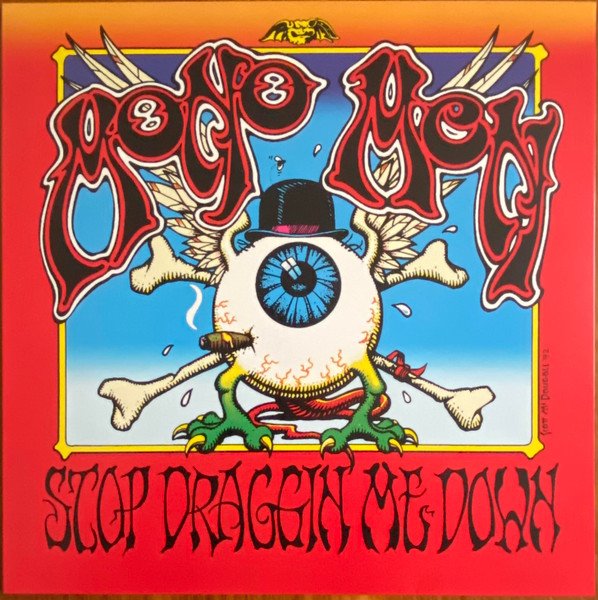
But Marx’s heart was no longer in it and he played his last show with the band on a weeknight in February before moving to Seattle. The late John Mortenson would be recruited to fill Marx’s role and together the Mono Men would lean into the fertile pastures of Wrecker. In 1991 after several runs, they were content to let Stop Draggin’ go out of print until the first re-issue later in the decade— with new Chantry design and McDougall illustration.
The band affectionately refers to this record as Stop Draggin’. You can call it that or you can call it Stop Draggin’ Me Down or Draggin’ Me Down or SDmD or Stop Raggin’ or even the first record. They won’t have any way of knowing what you call it and it’s not important anyway. Plus we really don’t even need to talk about the record itself, do we? You’re listening to it right now. You know the menace of the title track. The urgency of ‘Right Now.’ The noddy swing and incredibly unsafe solo break in ‘I Don’t Care.’ Put it on and turn it up, we’ll talk about it later…
— Callous French